
Editorial
Living Off the Keyboard
WRITING IS HARD WORK. Creativity isn’t necessarily fun, although sometimes it can be. Mostly you do it because you are driven. Writing is a passion. You would rather write than eat, or watch television, or bathe, or have sex. Well, sex may be an either/or, but the passion to write definitely gives the passion to make love a run for its money. You can learn to write in the sense that you can take classes or workshops that give you the opportunity to hone your skills. But you don’t decide one day, maybe after reading a good book, that you’d like to give the writing thing a shot. You’re kinda born with the writing gene.
The reason for this outburst of sentimentality is that I awoke this morning with the realization that within eight months I will be turning seventy-years-old. The big Seven-O. Seems so patriarchal.
I was noncommital about Two-O, but that year was greatly overshadowed by the magical twenty-one that is a rite of passage. Three-O bothered me a bit. I was freshly, joyously, divorced. On the flipside, I’d just lost my job and that seemed ironic. I was free but had no money to spend on wine, women, and song. Four-O and Five-O (“Book ’em, Danno!”) came and went with nary a blip on the lifeline radar screen. Although at fifty I insisted I was middle-age because fifty is halfway to one hundred. I intend to live to that ripe old age, at least. My family has terrific biology and most of us manage to attain centenarianism unless run over by a Freightliner.
For some reason, sixty didn’t ruffle my feathers, either. I guess because the prospect of retirement, not having to work (much) for a living, and getting money from the government on a regular basis, trumped the fact that I had now begun to lose teeth, took bathroom breaks more frequently, and was rapidly morphing into Gandalf the Gray.
Seventy? I can remember when my father turned seventy. So rather than look ahead at my impending doom—after seventy, the next milestone is eighty, a score of birthdays, and then I am a footnote in the pages of history—I look back at how this all began. Cue the fog filter.
Back when I was in grade school, there were no such things as personal computers. My aunt had a typewriter—a ponderous machine that would kill you instantly if it accidentally dropped on your head. Whenever we visited my aunt, I would be drawn to the magical instrument like a sailor to a Siren. Others wanted to go out and play with my aunt’s dog, or catch up on the latest gossip with friends and family we hadn’t seen in months (my aunt lived a good day’s drive distant). I wanted to lovingly roll a page of crisp white paper into the gleaming black monster, hit the keys, and watch my words be committed to real ink and font. Handwriting was ephemeral. This was for posterity.
Back then it didn’t matter much what I wrote. I could write anything. Through the magic of the typewriter, whatever I wrote I was an expert on, and my prose was on a par with Hemingway, or Steinbeck, or Melville, despite the fact that I had no idea who these people were.
Explaining the culture of the typewriter to humans born after the Smith-Corona Era is a bit difficult. You have to imagine being limited to handwriting throughout your formative years. Children could rarely afford personal typewriters; they were not widely available in grade schools for other than mimeograph use, which is a whole other story by itself. There is something unique about the aroma of mimeograph ink.
Fact is, one spent years grinding out essays and book reports with pencils, fountain pens, ballpoint pens, on lined paper, keeping within the margins. We suffered with “writer’s cramp” back then. Today the occupational hazard is carpal tunnel syndrome.
Ironically, most high schools offered Typing as a capital T curriculum acceptable course. I took Typing; that’s where I learned to type. But this was a skill offered to enhance job prospects after graduation (for girls), not to use for an essay due Friday on “How I Spent My Summer Vacation.”
Because I only encountered set type in newspapers, books, and magazines, when I was finally able to wax prosaically at the keyboard, my words inherited the same quality of authority as what I read in publications that you had to pay for. Delusional, of course. Today anybody can produce justified text in a variety of fonts on a smartphone, for Chrissake!
It may have been Fourth Grade. I’m not sure. In class we all had to write a poem. The class would vote. The winning poem got set to music and the entire class would sing it. I won. Of course I won. How could I not have won? That early peer adulation for my verbal skills was intoxicating and addictive.
In high school I had a typewriter of my own. Older, I began to explore the form known as the short story. Back then there were lots of magazines that published short stories. They even paid for them. Reading was quite popular. It was not 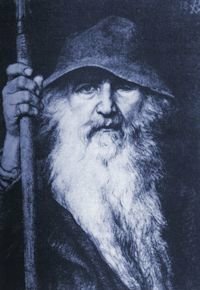 unusual to visit a park or a beach and notice lots of people sitting around with their noses in books or magazines instead of texting on tiny screens. My favorites were the science fiction pulps—“Analog,” “Galaxy,” “The Magazine of Fantasy & Science Fiction.” So I began to write science fiction stories. It wasn’t very long before I actually completed a story, and mailed it off to one of the magazines, self-addressed stamped envelope included, and got back my very first rejection slip! I was in the big time now. No doubt about it.
[Left, Odin the Wanderer, by Georg von Rosen, appeared in the 1893 Swedish translation of the Poetic Edda.]
Kids don’t have enough life experience to write credible, identifiable, nor authentic fiction. They aren’t worldly enough to get into a character’s skin, their ear isn’t tuned to dialog. Having a pet goldfish die doesn’t constitute loss; a snowball fight is not rage.
I called my father who is ninety-four years old, winters in Florida, plays golf, and still operates a car remarkably well. “Did you ever expect you would have a son who is seventy-years-old?” I wanted to know. He laughed. I have two brothers. One is a year and a few months younger. The other is almost five years younger. Not such huge gaps when we are all in our 60s. “I may have three of them!” he responded. He clearly still has his wits about him. I hope I do too when I am his age.
As a teenager, it would be years before I published anything for real. In the meantime I accumulated an impressive collection of rejections. I could sort them by sizes, colors, magazine logo. The cream of my collection were the handful of rejections personally annotated by the Editor. This meant that my work had gotten past the “slush pile” and was good enough to warrant a decision from the Editor. My high school friends may have prided themselves in completing an assigned essay from the teacher, but I could show them a fistful of proof that my work had been seen and deemed unworthy by the literati of the outside world. So there!
In college, I majored in journalism. I joined the school newspaper. It was actually in reverse order. I joined the newspaper before I switched my major to journalism. I began as a chemistry major, with the ambition of becoming a science and science fiction writer like Isaac Asimov who had a Ph.D. in biochemistry. My writing was better than my chemistry, however, and the editor of the school newspaper convinced me to defect to the journalism department. Cuter women in J-School, anyway. I met my first wife there.
I haven’t yet met my second wife, but I’m only seventy. To quote the 1959 science fiction film “On the Beach,” which I am old enough to remember premiering in theaters, “There is still time ... Brother.”
Is there? Of course there is! Flash forward to the present day. Cue the fog filter again.
With over twenty-five years of experience in the trenches of that concrete hell known as New York City’s publishing industry as an editor and writer, and another decade of free-lancing, and coming up on three years as editor of “Perihelion,” I have seen boatloads of manuscripts from all sorts of writers: those who are driven; those who think it might be fun—the wannabes; and those who should seriously consider selling aluminum siding for a career.
Admission to the septuagenarian club confers certain rights, privileges, honors, and marks of distinction. I can officially chase neighborhood children off my front lawn. I can fall asleep during meetings. I can wear my liver spots proudly.
I will do none of that. As little as possible, anyway. Age, as they say, is only a number. I don’t feel seventy, most of the time. I don’t look seventy. And, more importantly, I’m told that I still act like I’m twelve! “Won’t you ever grow up, Little Toot?” Not when I have the next issue of “Perihelion” to get out.
I think that is my point. As the clock ticks inexorably toward a rapidly decreasing number of milestones, one can be sentimental about one’s lifework.
If you have the passion, you gotta write. If you can’t break into the best-seller lists, you still gotta write. You gotta make a living, too. But selling designer sneakers during the day and working on your latest novel at night doesn’t hack it for those of us with the writing bug. For decades we got up before the sun, ate a less-than-nutritious breakfast, suffered an inhumane subway or bus ride into the office where we put up with an overweight publisher whose idea of passion was a quick smack on the lips from the wife, all for the joy of seeing our words under our bylines, in print. In retirement, at sixty-nine going on seventy, I feel exactly the same way about what I post on the Internet, minus the daily grind.
Here’s to another seventy years. Sixty-nine is the new forty-five.
Sam Bellotto Jr.


 About Our Cover
 BY SAM BELLOTTO JR.